Compliance with Sustainability Criteria for All Renewable Gaseous Fuels Placed on the Market
Environmental protection and ensuring the sustainability of energy sources are key priorities of the Renewable Energy Directive (EU) 2018/2001 (RED II). This directive strengthened the mechanisms for verifying sustainability criteria, particularly in the production or import of “biogas”, defined as any gaseous fuel produced from biomass. This definition includes biomethane. These mechanisms were transposed into national legislation by Decree‑Law No. 84/2022 of 9 December, in its current version.
The aforementioned RED II has since been amended by Directive (EU) 2023/2043 of 18 October (RED III), which is awaiting transposition into national law, to take place before the summer of 2026.
Biomethane and the Relationship Between Guarantees of Origin (GO) and Proofs of Sustainability (PoS)
Biomethane is a renewable fuel with characteristics very similar to those of fossil-derived natural gas, but from a renewable source. The issuance of a Guarantee of Origin (GO) for the gas produced serves to prove its renewable origin but does not prove that the biogas/biomethane was obtained in compliance with the sustainability criteria required by the European Renewable Energy Directives (RED II and RED III).
For this purpose, the biomethane produced or imported must be accompanied by a Proof of Sustainability (PoS), which demonstrates that the production chain has met sustainability criteria regarding the type and origin of the raw material, as well as greenhouse gas emission reduction criteria based on the production chain as a whole.
What Are Proofs of Sustainability (PoS)?
A PoS is a document containing detailed information on all the raw materials used and their origin for that batch of biomethane produced or imported. It also includes the history of accumulated greenhouse gas emissions across the value chain, considering, amongst other things, emissions from the processing of the raw material or waste, the transport of the waste to the production plant, and finally the sum of emissions resulting from the transport of the gaseous biofuel to the consumer.
Who Verifies Compliance with Sustainability Criteria when biomethane is placed on the market?
In Portugal, verification of sustainability criteria is carried out by the– National Laboratory for Energy and Geology (LNEG I.P.), through the Coordinating Entity for Compliance with Sustainability Criteria (ECS).
ECS receives and analyses the documentation submitted by economic operators involved in the production or import of biomethane and verifies whether the operator correctly issued the Proof of Sustainability (PoS) under an International Voluntary Scheme recognized by the European Commission.
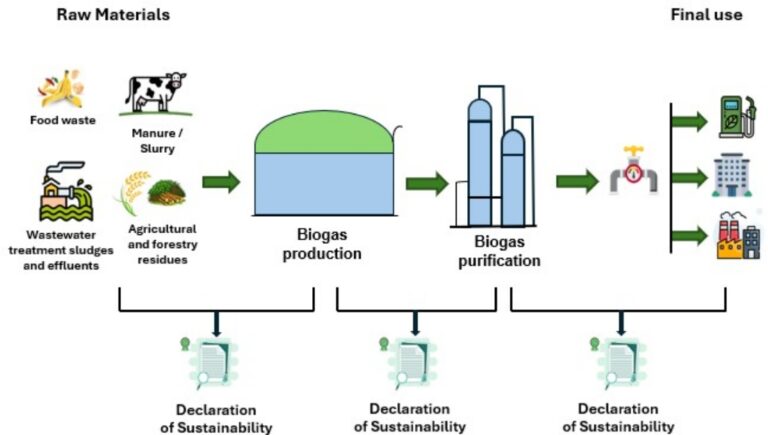
Biomethane, as a renewable gas, has broad application potential, ranging from industrial uses to the residential and transport sectors (see figure below).
For more information, please contact ECS at: ecs@lneg.pt
Schematic representation of the biomethane production process, from feedstocks (food waste, manure/slurry, sewage sludge, and agricultural and forestry residues), through biogas production and purification, to the different end uses, with the corresponding Sustainability Declarations (PoS) throughout the entire value chain.
 Portal for Biomethane